
What is ΔLAB-THC?
Understand the formulation before discovering the products that use it.
What inspired ΔLAB-THC ?
When someone ingests THC, the molecule is absorbed and then metabolised, mainly by the liver.
Compounds produced by this metabolism include 11-hydroxy-THC, commonly called 11-OH-THC. Other hydroxylated compounds can also appear along THC’s different metabolic pathways.
This mechanism was the starting point for the positioning of ΔLAB-THC : building a formulation around hydroxylated forms related to THC rather than creating yet another marketing name.
The name ΔLAB-THC therefore refers to a Delta-Lab formulation , not the scientific name of a single molecule. The exact composition must be documented by testing the batch concerned.
Important : ΔLAB-THC should not be confused with a molecule naturally called “ΔLAB-THC”: it is the name given to a formulation developed around hydroxylated THC compounds.
10-OH & 11-OH: two hydroxylated forms
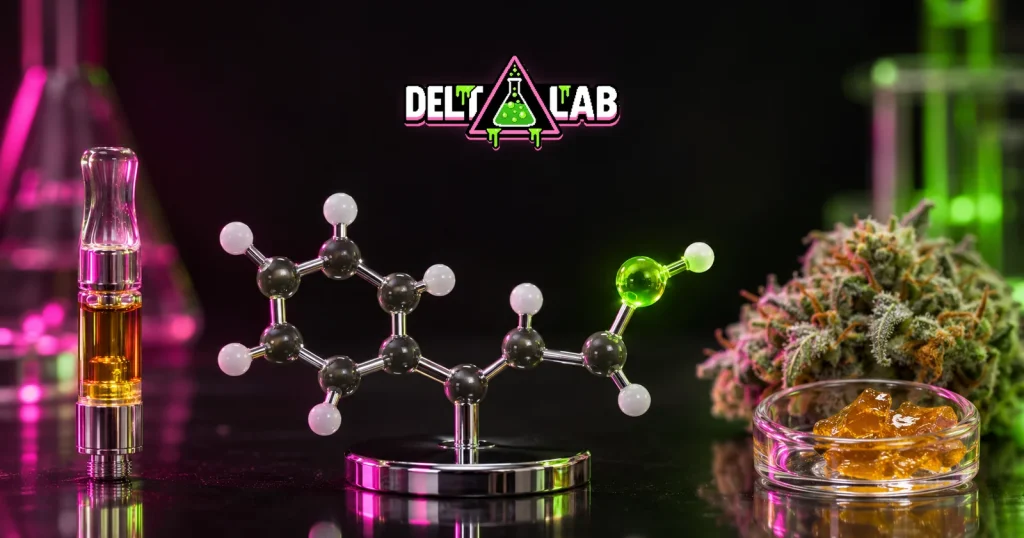
Here, the term “hydroxy” means that a hydroxyl group is present on the THC molecular skeleton.
Where this hydroxylation sits matters: two molecules sharing the same overall skeleton can have different properties when the change is on a different carbon.
10-OH : Hydroxylated form
The term 10-OH-THC refers to hydroxylation at carbon 10 of the THC skeleton. In the ΔLAB-THC range, this form is one of the chemical references used in the formulation.
11-OH : Known metabolite
11-hydroxy-THC is an important metabolite formed mainly after THC is ingested. Its role in the effects of ingested products is much better documented.
Science check : 11-OH-THC has a much larger body of scientific literature than some other hydroxylated forms. So you should not assume that all “OH-THC” variants have exactly the same pharmacological properties.
What is behind the ΔLAB formula ?
The range’s specifications are based on purified cannabinoid extracts and a formulation built around targeted hydroxylated forms.
The aim is not to present the product as a mysterious new molecule, but on the contrary to be able to state what the formulation is designed to contain.
The range’s positioning rules out, in particular, using hydrogenation or acetylation routes to produce the stated compounds.
Purified extracts
The stated starting point is cannabinoid material purified before formulation.
Hydroxylated forms
The formulation targets 10-OH and 11-OH type compounds rather than a hydrogenated or acetylated family.
No acetate
The specifications do not rely on acetylated cannabinoids such as THC-O or HHC-O.
No PINACA structure
The formulation is not presented as belonging to the indazole-PINACA families of synthetic cannabinoids.
CB1, CB2: how to read the science
The endocannabinoid system includes, among others, the receptors CB1 and CB2. Cannabinoids can interact with these receptors very differently depending on their structure.
Δ9-THC is mainly known for its partial activity at the CB1 receptor, which plays a major role in its psychoactive effects.
However, it would be too simplistic to automatically infer the profile of a new formulation from its name alone or from the presence of a hydroxylation.
That is why Delta-Lab separates here the biological model that inspired the formula from the properties actually proven for each compound.
CB1 : Nervous system
CB1 is widely present in the central nervous system and is a major target of Δ9-THC.
CB2 : Peripheral distribution
CB2 is distributed differently, notably in several tissues and cells linked to the immune system.
No extrapolation
A commercial formulation alone cannot precisely predict its pharmacological activity.
No marketing science : Terms such as “partial agonist”, “CB1 affinity” or “metabolite” have a precise pharmacological meaning. They should not be used as simple synonyms for “milder” or “stronger”.
HPLC, GC-MS & batch testing
A range name never proves a product’s composition on its own.
To document a batch, you need to be able to link the product sold to a lab report showing the compounds tested for, the results, the date and the sample reference.
Delta-Lab’s specifications use complementary chromatography tests to characterise the batches concerned.
HPLC
Liquid chromatography used to separate and measure the targeted analytes.
GC-MS
A complementary test combining chromatographic separation and mass spectrometry.
Batch
The lab report reference genuinely matches the goods produced and packaged.
Lab report
The report must state the laboratory, date, analytes, units and results.
Check the batch : A raw-material analysis does not automatically describe the finished product. To compare two products, always check the batch linked to the name, the material tested and the units used.
Where to find ΔLAB-THC ?
ΔLAB-THC vapes
Cartridges and devices in which the formulation is blended into a cannabinoid base suited to the product.
ΔLAB-THC flowers
Flowers infused with the formulation, with concentration and composition stated for the final product.
ΔLAB-THC extracts
Concentrated formats that deliver the formulation without flower.
Responsible use : Psychoactive products are for adults only. Check the composition of the product (lab analyses available on request), do not drive after use, and check the regulations in your country.
One formulation. Two references. One batch to check.
ΔLAB-THC is above all the name of a Delta-Lab formulation inspired by hydroxylated forms of THC. Its actual composition should always be judged from the lab analysis, not from the trade name alone.
Any questions? Contact us.
The news in your inbox
One email when there is a new drop or a deal. Never more than one a week.
One-click unsubscribe in every email.