CBD vs THC: What’s the Difference? Effects, Law, Drug Tests
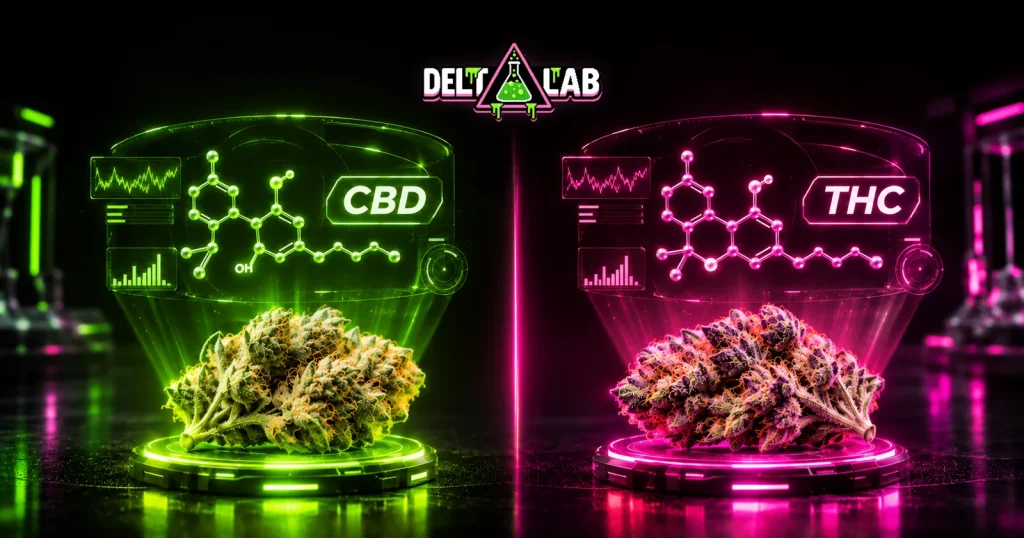
CBD and THC are both hemp compounds, but only THC is psychoactive. CBD doesn’t change how you perceive things. In most of the EU, hemp products are built around a 0.3% THC limit. Here’s what actually separates the two: effects, EU law, driving, and where THCA fits in.
What’s the difference between CBD and THC?
The real difference is what they do to your head: THC changes perception, CBD doesn’t. Both are cannabinoids, molecules the hemp plant makes on its own. They share the same chemical formula, but their atoms are arranged differently, and that small change decides everything.
- THC (delta-9-tetrahydrocannabinol): the compound that gets you high. It’s the one the law watches.
- CBD (cannabidiol): no recognised psychoactive effect. That’s why it can be sold, within the limits each country sets.
This guide isn’t about health. Neither CBD nor THC is a medicine, and no Delta-Lab product promises any effect on your body.
CBD vs THC at a glance
| CBD | THC | |
|---|---|---|
| Full name | Cannabidiol | Delta-9-tetrahydrocannabinol |
| Psychoactive | No | Yes |
| Legal status in the EU | Not a narcotic under EU law (CJEU, 2020) | Controlled; hemp products are capped around 0.3% THC, rules vary by country |
| Shows up on a THC drug test | No, but CBD products can carry trace THC | Yes |
| Found in | Hemp flowers, resins, extracts | Hemp, in amounts that vary a lot by strain |
Is CBD legal in Europe?
CBD itself isn’t a narcotic under EU law. The Court of Justice of the EU ruled so on 19 November 2020 (Kanavape, C-663/18): a member state can’t ban CBD legally made in another member state unless it proves a real public health risk.
That doesn’t make every CBD product legal everywhere. Each country sets its own rules on THC levels, product types and age limits. CBD food (oils to swallow, gummies, drinks) is a separate case: under EU “Novel Food” rules it needs an authorisation it doesn’t have yet, and France stopped allowing it on 15 May 2026.
Check the law where you live before you buy. Our guide to THCA effects and legality in Europe goes country by country.
Can CBD make you fail a drug test?
Yes, it can. Roadside saliva tests look for THC, not CBD, but many CBD products contain up to 0.3% THC, and those traces can be enough for a positive result.
In France, the top criminal court confirmed in 2023 that drug-driving is an offence as soon as THC is detected, whatever the amount and even if the product was legal. Other countries have their own rules. The simple answer: if you’re driving, don’t use any hemp product beforehand.
Where does THCA fit in?
THCA is a third molecule: the acid form of THC, found in the raw plant. It’s neither CBD nor THC, and its legal status depends on the country. We break it down in THCA vs THC: what’s the difference? and in our THCA legality guide.
When you compare CBD and THCA products, read the product page first: cannabinoid levels, origin, and lab analyses available on request.
FAQ
Does CBD get you high?
No. CBD isn’t psychoactive, unlike THC. A CBD product can hold a little THC (0.3% max in most EU countries), but not enough to count as a narcotic.
Does CBD contain THC?
Often a little. CBD flower comes from hemp strains that naturally carry trace THC, below 0.3%. CBD isolates are made to keep CBD only.
Is CBD legal in Europe in 2026?
CBD isn’t a narcotic under EU law, but each country sets its own rules. CBD food is not authorised at EU level, and France has banned it since 15 May 2026.
Can CBD make a saliva test positive?
Yes, because of trace THC. The test doesn’t detect CBD, but it does detect THC, even in small amounts. Don’t drive after using a hemp product.
Find the right product at Delta-Lab
Looking for CBD with no psychoactive effect? Head to our CBD range. More into stronger cannabinoids? Check our THCA products and THCA flowers, and check your local law first. Want to spot dodgy products? Read our investigation Fake CBD, fake CBC.
Order before 3 pm on a weekday and your parcel ships the same day. Adults 18+ only.
The news in your inbox
One email when there is a new drop or a deal. Never more than one a week.
One-click unsubscribe in every email.